Pilonidal Disease -Cyst & Sinus Treatment Options
Understanding Pilonidal Disease Treatment Options
Minimally Invasive Laser Procedure
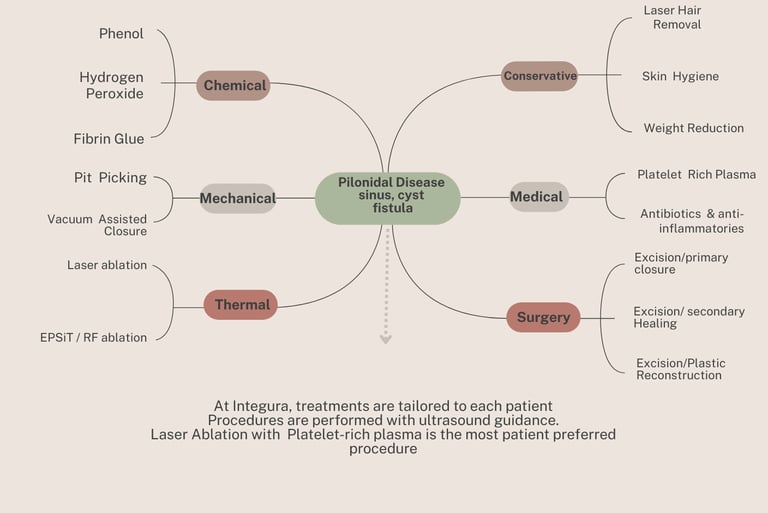
Pilonidal disease can appear as a sinus, cyst or fistula, and no single method works for every patient. This is why it is important to understand the full range of treatment options shown in the chart above. These treatments are grouped into Conservative, Medical, Chemical, Mechanical, Thermal and Surgical approaches to give a clear overview of how pilonidal disease can be managed.
Conservative treatment focuses on prevention with laser hair removal, hygiene, diabetes control and weight reduction. Medical management includes antibiotics, anti-inflammatory medicines and platelet-rich plasma (PRP) to support healing.
Chemical treatments such as phenol, hydrogen peroxide and fibrin glue aim to close or shrink the sinus.
Mechanical treatments, including pit picking and vacuum-assisted closure, target the tract with minimal intervention.
Thermal treatments such as laser ablation and EPSiT/RF ablation use controlled heat to destroy the sinus lining with fast recovery and minimal downtime. For more advanced cases, surgical treatments such as excision with primary closure, secondary healing or plastic reconstruction may be required.
At Integura, all treatments are tailored to each patient and performed under ultrasound guidance for precision and safety. Among the minimally invasive options, laser ablation with platelet-rich plasma is currently the most preferred by patients due to its effectiveness, low pain and quick return to normal activities.
In addition, we focus on long-term prevention by addressing hair management, skin health and lifestyle factors that reduce recurrence. By combining modern minimally invasive techniques with supportive care, we provide a comprehensive pathway for patients seeking effective and reliable pilonidal disease treatment.
Contact
© 2025. All rights reserved.
care@integura.co.uk
Clinic Address
7 Blyth Road
Bromley BR1 3AR